
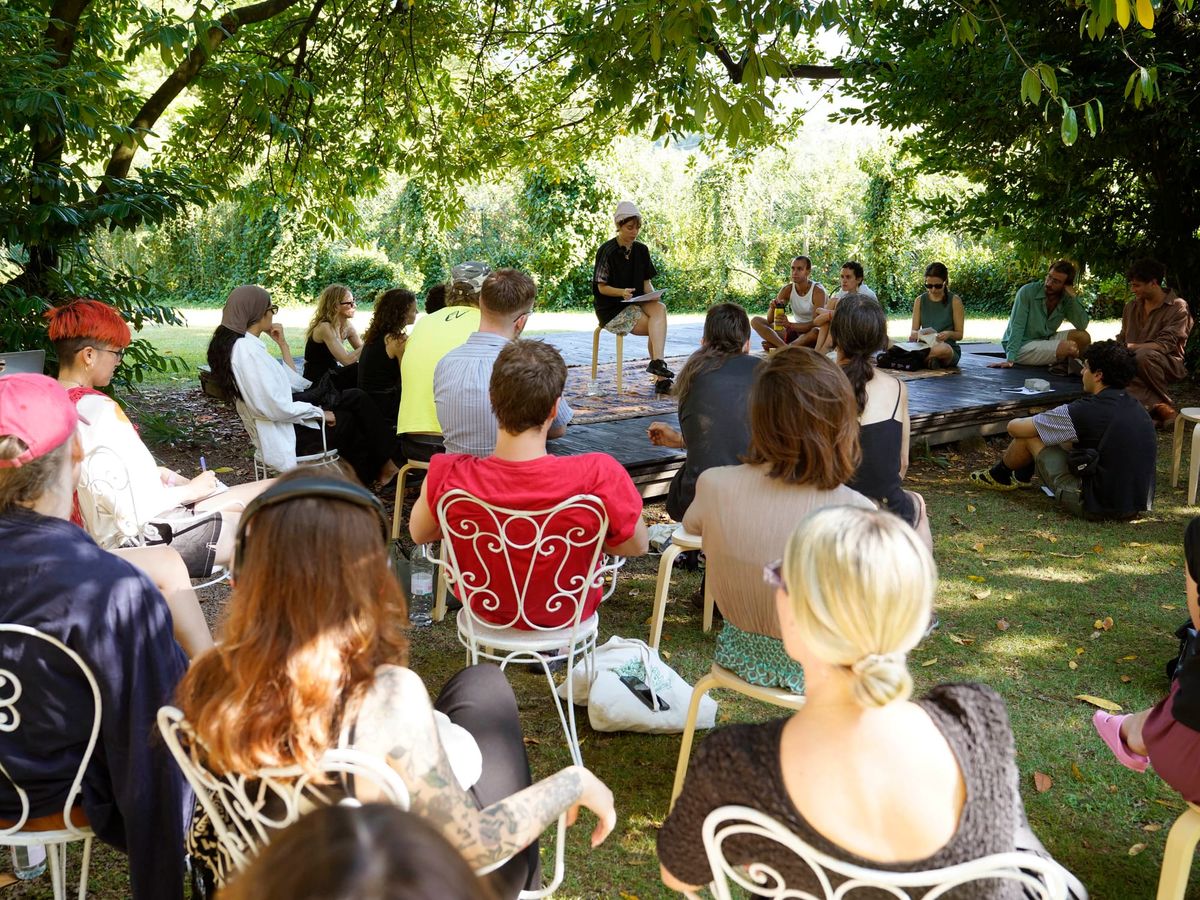
For the past fourteen years, Simone Frangi and Barbara Boninsegna have organized the Free School of Performance within the “Live Works Summit” at Centrale Fies. The international platform and scouting tool for contemporary performance art expands from practices rooted in the visual arts into the borderlands between performance, research, activism, and interdisciplinary experimentation—embracing the most hybrid and political forms, and committed to deepening the very notion of performance itself.
The text published below was conceived as a performative lecture as part of the discourse program of the Free School: a meditation on the body, its postures and exhaustion. It moves through four bodies: the individual, mundane and aching; the periperformative, caught in language and its near-misses; the ecosystemic, porous and shared with others named differently—or not named at all; the dissociative, which exits itself and lingers nearby, unguarded. Between them lies the question of what it means to stay with pain—personal, chronic, geopolitical—without resolving it, naming it, or forgetting it.
*
Intro
…I always assumed that the most useful work [of this sort] is likeliest to occur near the boundary of what a writer can’t figure out how to say readily (never mind prescribe to others)
…to borrow Eve Kosofsky Sedgwick’s words.
[...]
When words finally reach me, they cross through, and cross over, and transform themselves into tangibles.
Everything that touches these words has been touched by others.
1: The individual body (or the mundane)
On the aching body. It’s been 2 birthdays already. First it was a harsh hit of acute pain arriving right on time: when the relaxing body returns to being a working body. One morning I got up from bed, and since the weather was still warm in early September, I decided to put my skirt on. While I bent to unzip it and put my legs through, an abrupt, electrifying pain tears me apart. I scream and freeze until my flatmate picks me up from a folded position and helps me lie down.
The pain kept me almost immobile for a month, and only gradually decreased and passed into forgetfulness. It was only a few months later that it hit me again. By then I started to recognize the symptoms and developed a patience/ignorance that would pretend it’s part of a daily routine. This phenomenon started increasingly returning to me, with a speedingly decreasing periodic tempo, to a point where today, it’s just part of the information that my brain processes daily.
While trying to articulate the messages that this pain, by now chronic, is giving back to me, I was looking into forms of chronic/ness that are too subtle to consider illness but yet present to [the] extent of disrupting the perception of one’s own body. I came across the term “dull pain,” which is used to describe (I quote) “deep ache, pressure, or heaviness rather than a sharp, stabbing sensation. It is usually steady and typically bearable.” Which leaves me wondering what the thresholds of bearability are and for whom. But, indeed, the dull pain, which I now name as my own dysfunctional routine, is very dull, in fact so dull, that I don’t want to have anything to do with it. So I will leave it behind for now, and forget about it in a few minutes.
In recent years, my curatorial research inquiries around the body have been deeply influenced by the geo- lens: geo- graphical, -political, -logical. I grew my interest directly from observing the conditions that my generation witness(ed) in the (eastern) European? Mediterranean region where I was raised. A lot has happened, and keeps happening, in these past 3 decades, so much that for many, oblivion became a temporary way of coping, moving from one day to the next. My belated arrival to art and theory allowed me other ways of observing these dynamics and negotiations, perhaps with a bit more intellectual detachment that was able to cover up the despair previously directly felt. While bringing those macro-spheres of deep time into the intimate scale of relations in compressed time, things quickly became personal and autotheoretical: how do these spheres oppose, collide and/or contradict each other?
There has been no departing point, rather a traversing line: questioning how bodies inhabit a space in reciprocity, and their transformative political capacity. What do we try to do when we are exploring perspectives of (dis)embodiment while making connections with its social and environmental conditions on which those perceptions manifest? I would like to stay with notions of aching from a perspective of and beyond the singular human body, like ecosystems enduring chronic pain via infrastructural and systemic violence.
What shapes the way things are being named and felt?
Take, for example, Teorija Koja Hoda, or otherwise known as Walking Theory, developed in and around Belgrade in the early 2000s by a group of researchers. As one of the founding members, Ana Vujanovic outlines in her homonymous essay, there was (and is?) a need for a theory that is socially grounded, mobile, and porous. In her words:
Walking theory is a theory that has a body, an actual and physical body, and as such, it cannot be an autonomous cognitive realm in relation to society. To say that it has a body means that it is determined by the real-existing subject of speech—their gender, class, age, skin color, etc. [...] To say that walking theory has a body also means that it is a discursive social practice, the activity of a theorist in their existing social circumstances.
Recently, after the strong recommendation of an orthopedic doctor, an osteopath, and a therapist, I turned to regular physical exercise. In a dance class that I hadn’t practiced for a long while, I heard our teacher repeatedly highlight: stretch the space between your bones, enlarge the space between your bones. Then someone from the people dancing alongside me asked: do you mean the bones of each other?
…
I think she means the joints, I answered and lowered my eyes towards my aching hip joint.
When I cannot afford to train additional hours in a dancing or Pilates school, I do it at home, online. Then the virtual instructor, trying to motivate us distant bodies to work harder, accentuates her voice when saying: reach reach reach reach reach reach…
I then visualize myself expanding beyond the walls of my room, beyond the sea, beyond any imaginary body.
2: The periperformative body (or the linguistic)
My favorite game as a kid and teen was ονόματα, ζώα, φυτά, πράγματα (names, animals, plants, objects) or the naming of things: the rule was that in only a few minutes, all players has to come up with a list of names, objects, living beings, topologies, edibles that start with a particular letter. It is a very competitive game, and to some extent I can imagine it quite neurotypical. I almost always lost but still loved it more than any other game. I guess it was the searching for words that made me so excited.
Clara, cake, crabs, cauliflower, crown, Colombia.
Recently, when applying to something and trying again to write about what I do for a living (I accidentally wrote loving: what I do for a loving), I started collecting verbs starting with the letter c. I was frustrated with calling myself a curator, so I started making lists of other verbs, so as to deviate from the exhausted etymological locus of curare that everyone loves going back to when reflecting on curatorial practices. I thought if I kept the same first letter, no one would really notice.
Complotting, as in making plot, as in those who dig together, as in those who nurture together, and each other, as in those who carry together, and each other, as in those who care together, and for each other, to not allow this word to be co-opted again.
If complotting could be used to expand on curating, then what other words could we see coming after?
When making plot, I thought co-inspiring would be the one to follow. To co-inspire, or conspire, is not only to stick brains together, an image I always found disturbing to a certain extent. Immediately, some would think of the so-called conspiracy theories and roll up their eyes. Instead, conspiring, like complotting, suffers in the realm of demonized language, which is meant to prevent any form of bond forming, of actually being a friend nearby, in solidarity with a more or less neighbour body.
This is a work in progress, and I am open to receiving any verb that comes to your mind.
I couldn't find the c-list to bring with me today, but I remember clearly one of the last words: to circulate.
Circularity standing here for a spatial configuration of the near and the “peripheral”, where things stay nearby.
Now I wonder what happens when all these words come together, what kind of spaces do they create and for whom?
Recently in a work-related context, I heard for the first time the word “perforate”. It is one of these cases where you recognize the word, but you don’t know what it means, so you try to create an image out of it. I honestly do it in all languages that I am more or less able to communicate in. As I am often relying on images to describe something when language or my vocabulary fails to support me, I turned to that method to understand what my collaborator meant. Perforare, from Latin, is to pierce through: it might sound quite self-evident to some of you growing up close to variations of English tongues. Or not. Let’s stay with the not-assuming-attitude that keeps us present in these spaces.
Perforated surfaces are opportunities of seeing through. Piercing through to find an openness, a space to breathe. We make a little hole and see what happens, what goes through our impenetrable lives, lives born out of fragility.
Can we perforate despair?
To break through, on the other side of this bottomlessness.
Patrick, pie, peacock, peppermint, pencil, Paris,
Protesting.
Bodies, written upon, chant themselves into the space of censorship, lungs and vocal cords trembling, navigating exhaustion but not isolation, performing spaces of materialization, left with quick arrest and dissolution.
Could perforate describe that image? Or pierce through it? And where do we go from there?
Shame! Shame! Shame! We all shout on the streets.
In Eve Sedgwick’s concept of periperformativity, other utterances are included that, while not falling under the category of “explicitly performative utterances” of [J.L.] Austin’s widely cited work How to Do Things with Words, nevertheless refer to them in some way. According to Sedgwick, “Periperformative utterances aren’t just about performative utterances: they cluster around them, they are near or next to them or crowding against them. They are in the neighborhood of the performative.”
https://www.instagram.com/reel/CzomnfnocoL/?igsh=MWJwcXZobmJubjM0cg==
'Rutte schande, bloed aan je handen'
If conspiring and complotting can be looked at differently through the lens of friendship and solidarity, then what would one say about complicity? What are the terms this word has been created and read through in the past decades, especially the three years of endless genocidal wars that are raging in front of our eyes?
Recently, in a movement session, I tried this exercise where you had to close your eyes and imagine your body is not frontal (which is not) and virtually place your eyes on your back, on different heights and sides of the body. If for some of us, the contact seems to be a screen via a disconnected and delusional geographical distance, then is it really only virtual? And if so, are our phones and screens becoming complicit in making us numb to the empire’s necropolitical breakfast, served so casually once we open our eyes?
Where are these images and sounds to be found? Where is the smell, the debris, the dust, the humidity, the dryness, the stretchiness?
Who is the living and who is the dying?
Who is lived and who is dead?
And what is this fraction of time and distance that separates or “protects” someone from this state of being? I don’t think it’s a coincidence that words don’t come out anymore.
Is it hard to tell, or hard to listen?
Here are some words by Lebanese artist Hussein Nassereddine in his Manifesto for the Arts of the Coming South:
What do we say now, and what do we fabricate, while our hands are busy holding the dead? What comes after witnessing, and how not to get blinded by the smoke? This horizon is split open now; how do we go through it? And what do we say before fates take us to the side of the dead? How do we return now, or soon, to places that have left their inhabitants? With what texts and which forms? Perhaps what we will do next should be completely detached from what we are doing now, as the mountains have detached from themselves.
[...]
If we turn our gaze to the direction of the south, knowing that it is there, behind the head, in that place that one cannot see when the neck turns, perhaps we will finally be made aware of this duality of time: our time, that we count day by day, the slow, lethal time like waiting, and the time of the thousand years, flowing down loud like a river. These two times, running on two banks, never meeting—let us call them regular time and the time of the unseen.
Perhaps, if we turn our gaze now, we will realize, finally, that the south has entered the time of the thousand years.
3: The ecosystemic body
We are living in a world that doesn’t taste right, writes Alexis Pauline Gumbs in the M Archive.
We are trying to get rid of its bitter taste; we spit it out every once in a while. We produce excess saliva, an accumulation of bitterness, grief, sorrow, rage. We accumulate it until our tongues start floating on it. We spit. Our mouths are dry; we feel empty but temporarily released. Seconds after, the bitterness of this world reappears in our mouths.
It’s a continuous loop.
In her book The Second Body, Daisy Hildyard claims that every living thing on this planet is in possession of two bodies: its “physical” body and the body that is bound to its multiple relating ecosystems. The physical body is perceived as individual in the way that it performs eating, sleeping, discharging, making love, going to work. The second one is the one that is materially and chemically linked to other bodies, of species named differently, or not, of those whose texture feels foreign and conditions of life not shared.
An ecosystemic body.
To collapse these bodies into one, into one’s own hosting body, is to encounter the feeling of the constant switching between the self and the world.
Pauline Gumbs continues:
They dug in their memories for one day. For some of them it was a couple of days per month, rock-bottom days. The days in their lives when the world had already ended. They thought back and asked:
What did we each do then? On the day that everything went wrong. [...] when we personally couldn't get out of bed, dehydrated with crying. When we didn’t ask for help. When we hurt the people we loved. When the sun died. When we lost everything. When we lost exactly who we needed to save. When we knew there would be no tomorrow, what did we do to each other then? How did we keep breathing past it (because we are the ones that did). They dug for those memories and stacked them in a row.
That’s how. That’s how we learned to get through this.
Deep swallowing.
(rest, take a longer breath, gather saliva and spit into the glass of water I have been drinking before)
The body, that is now moving back and forth, in other bodies and times,
rejects the freedom that has been denied to it.
Refuses to exist as a subject.
Escapes the bounded singular subject and becomes something else. Anything else.
4: The dissociative body (or the breaking of time)
Recently in a therapy session, I was discussing dissociation. My therapist, after hearing my ongoing complaints, pointed out how when I am about to commit to some specific tasks, my mind blacks out, and I end up with a vacuum in my head for some seconds, unable to remember my thoughts, let alone articulate them. In a somatic exercise we did she asked me to search for a bodily sensation. And while I was unable to search for any sensation, as I was entirely outside of my body, I automatically started oscillating on my desk chair. Like a pendulum clock.
In Wikipedia's description of that clock I read: Torsion clocks are unusually delicate, ornamental machines which require stable conditions to operate properly. The clocks are protected from the vagaries of air currents by a glass dome.
The fragility of a pendulum clock is not far from the one I feel when I try to keep myself in my body. Elvia Wilk writes about these dissociations in her recent book Death by Landscape, describing them as “crossovers”. Crossing to the other side, a side of unknown territory where the body is on its own, left unguarded. That time is interesting, as itself is not directly measurable nor perceived as such. Instead, it lingers above the body like a circular nebulous volume. I am interested in that immeasurability, when the body exits itself but is still nearby.
Crossing over to another body, or the neighborhood of that body. Instead of speaking nearby, one can adopt a body nearby, and the nearby happens in shifting proximities.
In Intermezzo #4, the body doesn’t lie, Ana Vujanović and Bojana Cvejić introduce a selection of contemporary techniques of the self guided by Foucault’s hermeneutics of the subject and trying to analyze the standpoint with the self óptimization. They explain that these body techniques represent a path toward self-knowledge. I quote:
For the body to become the locus of truth that one can experience in their own person, it has to be associated with a transcendent idea, like that of nature, which is either (pseudo)physiologically or spiritually posited, or that of freedom, predominantly understood in consciousness, spontaneity, intensified presence of affect or joy.
Each of these techniques conceives of nature in a slightly different manner, yet often with a certain nostalgia for the lost natural body.
Pauline Gumbs again:
She woke up on a planet with no land again, and all the leg strength she had built pushing her brain towards the sky, pushing the rock-hard reality down, standing up for this or that, was now for floating. In this water without salt shore. [...]
No land. Just love. No anchor. Just air.
[...]
When she touched the map, it moved!
Outro
In this text, I have welcomed fragments of other texts that would help a drained brain to think through performance and disembodiment in times of loss. One cannot help but notice three years of breaking news, and before that other breaking news, but after that no breaking news.
Because time broke away from any novelty, not even that of killing and dying.
Fragments because breathing has to happen in between. And perhaps more spitting of this despair mentioned earlier. A luta continua.
//
Cover Image
Angeliki Tzortzakaki, Live Works 2026, FREE SCHOOL OF PERFORMANCE. ph Alessandro Sala. Courtesy Centrale Fies
(she/her) works as a writer, curator, editor, researcher and occasionally performer in Amsterdam and her birthplace Crete.