
The issue regarding the assignment of ‘cultural’ and ‘aesthetic’[1] value, as well as scientific properties to certain cultural concepts, and artistic and functional artefacts from pre-colonial and colonial Africa, has not yet been overcome. The cultural heritage status and the commercial prestige they have acquired have fueled debate in the humanities for centuries. However, the data concerning strictly scientific properties, including their ‘scientific and technological value,’ which would suggest a certain intelligibility and scientificity in their conception and creation, has been systematically ignored by historians, anthropologists, and ethnographers. Rather, it was usually the spiritualist and ‘animist’ functions they were believed to have served in the so-called ‘primitive’ societies that elicited exoticizing views, which are prevalent in most colonial sciences. As an example of this, we can cite the sculptures (masks and statuary) – ‘fetishes’ or not – as well as woven textiles and other everyday objects, which have been produced through distinct methods and techniques perfectly mastered by the guardians of these crafts. Western art, from the beginning of the twentieth century, was strongly inspired by this, hence the emergence of the “primitivist modernists,”[2] with Picasso, Braque, etc.
Before acquiring the status of an object to be studied, or a work of art endowed with particular ‘aesthetic properties,’ objects of this category were generally seen simply as primitive artefacts or relics of societies not in contact with Western ‘modernity.’ It was therefore deemed necessary to ‘civilize’ these societies, laying ground for the ‘civilizing mission’ that the West assigned itself, executed through conquests, occupation, and colonization.
Coloniality refers to “the global articulation of a Western system of power that has survived colonialism and is based on the inferiorisation of non-Western places, human groups, knowledge, and subjectivities, and the exploitation of resources and vital forces.”[3] It characterizes most of the studies dedicated to what in this context we call “appointed guardianship.”[4] In this regard, Western epistemology presides, in terms of scientific methodologies and assessment criteria, feeding on the ideas established by Western ethnographic museology,[5] which originated in the 18th century. This process of museification has therefore played a major role in manifesting this way of looking at things, which involves taking shortcuts in our assessment of the other and their practices.
This identity transformation that brings about a change of status and allows access to a slightly more rewarding position – or, conversely, withdraws it –may be regarded as a sort of ‘ontological shift,’[6] bringing forth a change in perception regarding these achievements and concepts, while instituting, by tacit imposition, an ‘epistemological change.’[7] In this spirit, the project South-to-South
“[gathered] a group of artists, thinkers, and community organizers with the aim of sharing different branches of technology, art, and local cosmologies. [It was] dedicated to probing how traditional land-based knowledge and ancestral practices bear cosmological understandings of technology. For this, participants [focused] on re-orienting local technological systems towards the materialization of the Pluriverse. The Pluriverse is a world of many worlds in which diverse futures can be sown, multispecies realities can be nurtured, and a plurality of knowledges can achieve connectivity between the multiple world systems that constitute us.”[8]
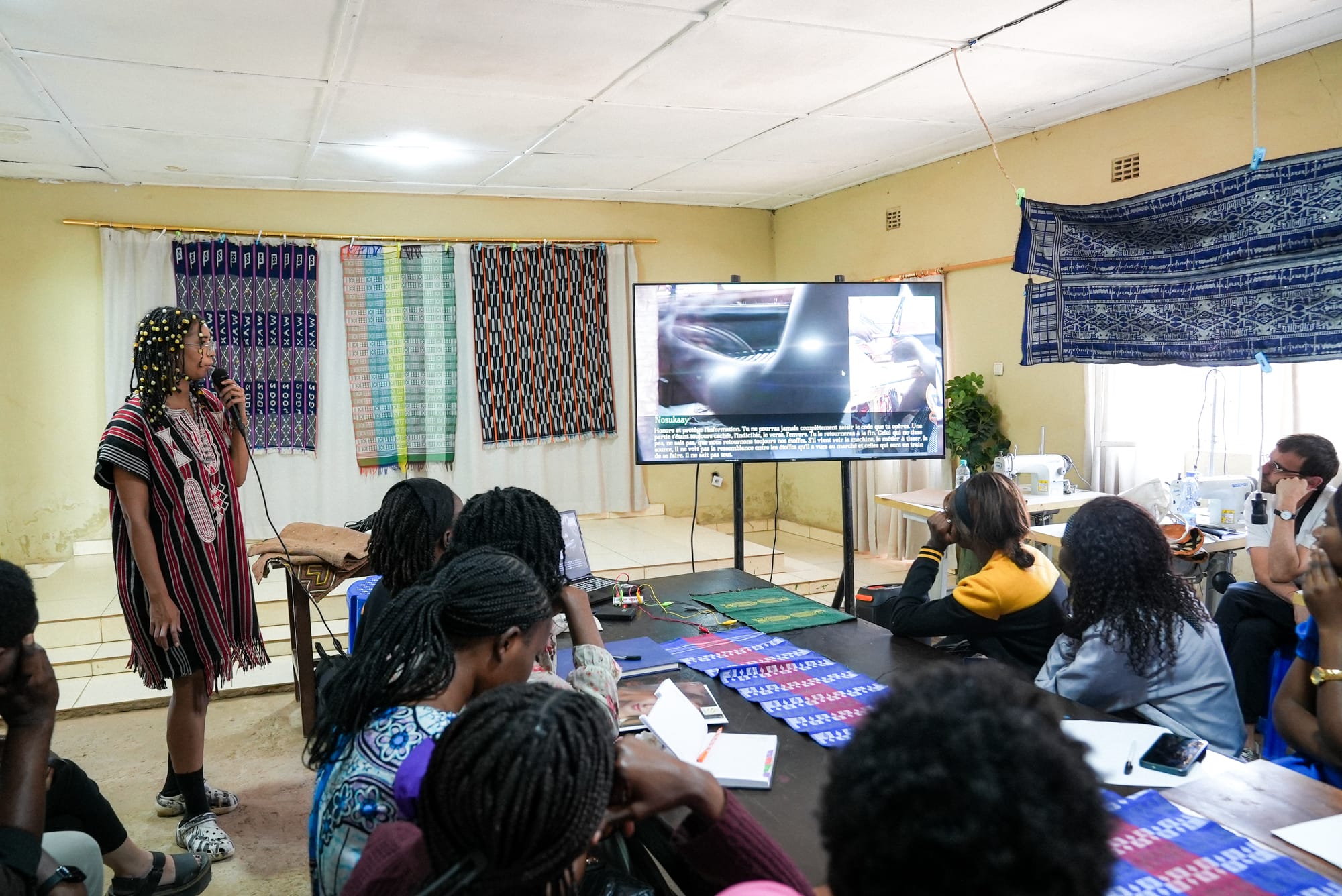
Fig.1
The Coloniality of Knowledge
Rooted in the “first contacts”[9] between Africa and the Western world, this evolutionist logic of designation – centered on assigning terms and values to concepts and objects – operates through mechanisms of coloniality and aligns closely with the notion of ‘coloniality of knowledge.’[10] This concept, itself grounded in the broader framework of the ‘coloniality of power,’[11] refers to scientific and other forms of knowledge that were exercised or instrumentalized within the colonial context to uphold Western domination. As a branch of the ‘coloniality of power,’ it reinforces the practice of “hierarchizing modes of knowledge production, elevating Western philosophy and science to the rank of paradigms which render other forms of knowledge subaltern.”[12] Developed by Aníbal Quijano, this notion deals, in other words, with the violence exerted by the West on the cultures of other regions. Subjects from the non-West, which, historically and systemically, is ultimately linked to the West, the latter perceived here not as a physical place but rather as a center of domination of the global capitalist system, adopting racism as a means to exert power, act as executors of the coloniality of power.[13]
Clearly, the effort to acknowledge (or even restore or showcase) the scientific and technological qualities of African objects and concepts adheres to an ostensibly natural linear order of classification: artefacts – works of art – technological objects. These vocabularies, along with the meanings they convey, follow a straight line drawn by Colonialism, with the institutionalization of Western paradigms and epistemologies positioned at its pinnacle, serving as the ultimate reference. It becomes apparent that, unfortunately, in scientific practice, the modes of validation follow a logic that is presented as universal, centering categories insidiously established by Western epistemology. Established as the standard and unit of measure, this epistemology remains the barometer for attributing value to practices from other regions and cultures.
Meanwhile, the effort to establish or demonstrate a certain scientificity in relation to these objects and concepts paradoxically reinscribes the very paradigms imposed by Western science. It is a trap.
“Even the ‘approaches claiming to be Afrocentric and grounded in authentic African traditions’[14] engage in processes of designation and value attribution that ultimately remain aligned with, or submit to, the 'Western epistemological order.’”[15] To attempt designation through comparative means – relying, from the outset, on Western language – is, clearly, a delusion; and this pursuit of equivalence is indisputably shaped by and continues to operate under the enduring influence of coloniality. Speaking, for example, of the practices of Dogon cosmogony,[16] or of the ‘scientific qualities’ of the Luba memory boards, generally referred to as ‘Lukasa,’[17] while using Western concepts and terms, reveals the attempt to seek elevation or accession to the ‘high’ spheres of Western discourse by aiming for equivalence; the case, for example, of the book “Philosophie bantoue”, written in 1945 by Placide Frans Tempels, who sought to apply the concept of “philosophy” to local African ontological conceptions, speaks volumes.
Alternative Epistemologies?
Escaping this influence requires very particular attention in the use and adoption of certain methodologies, a crucial approach to break out of the colonial agenda embedded in the humanities (anthropology, ethnology, history, etc.). We must decolonize the language we use by stripping it of its decried content. This is how this call for “the urgent amplification of knowledge and understanding of technology for a more-than-human world, relating to different cosmologies, knowledge, and more-than-human intelligence” and the aim to “understand technologies beyond capitalistic, neo-liberal, and neo-colonial frameworks of extracting knowledge, resources, or controlling systems against humans and non-humans”[18] could shed these burdens that have long haunted the humanities.
In other words, it would be necessary that we distance ourselves from assigning value based on categories that are imposed by a Western understanding of science; from these modes of knowledge that enforce themselves as standard and, in certain cases, define in which way and to which degree cultural production is to be understood. This oppressive and violent approach to the designation of things could be rebutted or transformed into a logic of pluriversality through the proposition of alternative epistemologies. Those should be specific, yet free from mono-directional Western modes of validation. It is therefore necessary to disregard biased anthropological conceptions and instead draw upon, explore, and employ the true meanings of cultural production marked as artisanal objects, artworks, or ethnographic and museologic artifacts within the cultures in which they reside and/or cultures of origin to give way to new definitions and approaches – starting, for example, from local languages, customs, and traditions, as well as the ontological concepts by which they are referred to. The original knowledge and details about these entities, hitherto ignored by Western science, must be reclaimed and considered – including, above all, their original names and applications. Whereas notions like science, technology, etc., must be broadened in their definition, or simply understood as only existing within a certain contextual framework.
Published within the framework of 99 Questions South-to-South: A Meeting on African and Afro-diasporic Technologies, Stiftung Humboldt Forum im Berliner Schloss.
//
Footnotes
[1] See Van Beurden, Congo en vitrine, Art africain, muséologie et politique [Congo Showcase, African art, museology, and politics], The Kinshasa and Tervuren museums, coll. “Studies in Social Sciences and Humanities”, vol. 180. Tervuren: MRAC, 2021, p.25
[2] Van Beurden, op.cit. p.128
[3] Rachel Solomon Tsehaye et Henri Vieille-Grosjean, “Colonialité et occidentalocentrisme : quels enjeux pour la production des savoirs ?” [“Coloniality and Western-centrism: what are the issues for the production of knowledge?”], Recherches en éducation [Research in Education], 32, 2018
[4] We were inspired by the concept of “cultural guardianship,” developed by Sarah Van Beurden, which she attributed to colonialism in the Congo. See op.cit.p.25
[5] “Western culture was the first to critically reflect upon itself (beginning in the 18th century). But the effect of this crisis was that it also began to regard itself as a universal culture, and it then brought all other cultures into its museum as vestiges of its own image. It ‘aestheticized’ them, reinterpreted them according to its own model, and thus precluded the radical interrogation these ‘different‘ cultures implied for it.” Jean Baudrillard Le miroir de la production, cited in Valentin-Yves Mudimbe: L’odeur du père [The scent of the father], Présence africaine [African Presence], Paris, 1982, p. 45
[6] Van Beurden, ibid.
[7] Van Beurden, ibid.
[8] Introduction to Sara Garzón and Michael Dieminger’s accompanying text for South-to-South: A Meeting on African and Afro diasporic Technologies at Centre d’Art Waza in Lububmashi, P. 4 [https://www.saragarzon.com/south-south-south-a-meeting-on-african-and-afro-diasporic-technologies-1]
[9] I am referring here to the age of European exploration expeditions beginning in the 15th century. While the term ‘first contact’ exists in Anthropology, both the term and the concept are subject to ongoing debate and critique within the field – particularly in the context of 'Africa' and 'the Western world.' Africa is a vast and diverse continent with a long history of internal trade and knowledge exchange, as well as interactions that have transcended its borders. In the Mediterranean, the boundary between Europe and Africa was historically porous, and trans-Saharan trade routes as well as and cross-Mediterranean networks existed long before the notion of colonization had even emerged. See also: Sidney Littlefield Kasfir (2021), “Art africain et authenticité : un texte purgé de ses ombres”, in: Cédrick Vincent (ed.): Art contemporain africain, Histoire(s) d’une notion par celles et ceux qui l’ont faite, Paris, Fondation Antoine Galbert & jrp-editions, pp. 54-89. The original text was published in African Arts in 1992.
[10] Rachel Solomon Tsehaye and Henri Vieille-Grosjean, op. cit., pp. 120-121
[11] ibid.
[12] ibid.
[13] ibid.
[14] ibid.
[15] See Valentin-Yves Mudimbe, L’invention de l’Afrique. Gnose, philosophie et ordre de la connaissance, trans. Mamadou Diouf and Laurent Vannini (Paris: Présence Africaine, 2021), originally published as The Invention of Africa: Gnosis, Philosophy, and the Order of Knowledge (Bloomington: Indiana University Press, 1988), p. 8
[16] See Marcel Griaule “Dieu d’eau,” cited by Mudimbe, ibid. pp. 318-319
[17] See https://www.metmuseum.org/art/collection/search/690570
[18] Introduction to Sara Garzón and Michael Dieminger’s accompanying text for South-to-South: A Meeting on African and Afro diasporic Technologies at Centre d’Art Waza in Lububmashi, P. 3 [https://www.saragarzon.com/south-south-south-a-meeting-on-african-and-afro-diasporic-technologies-1]
Images:
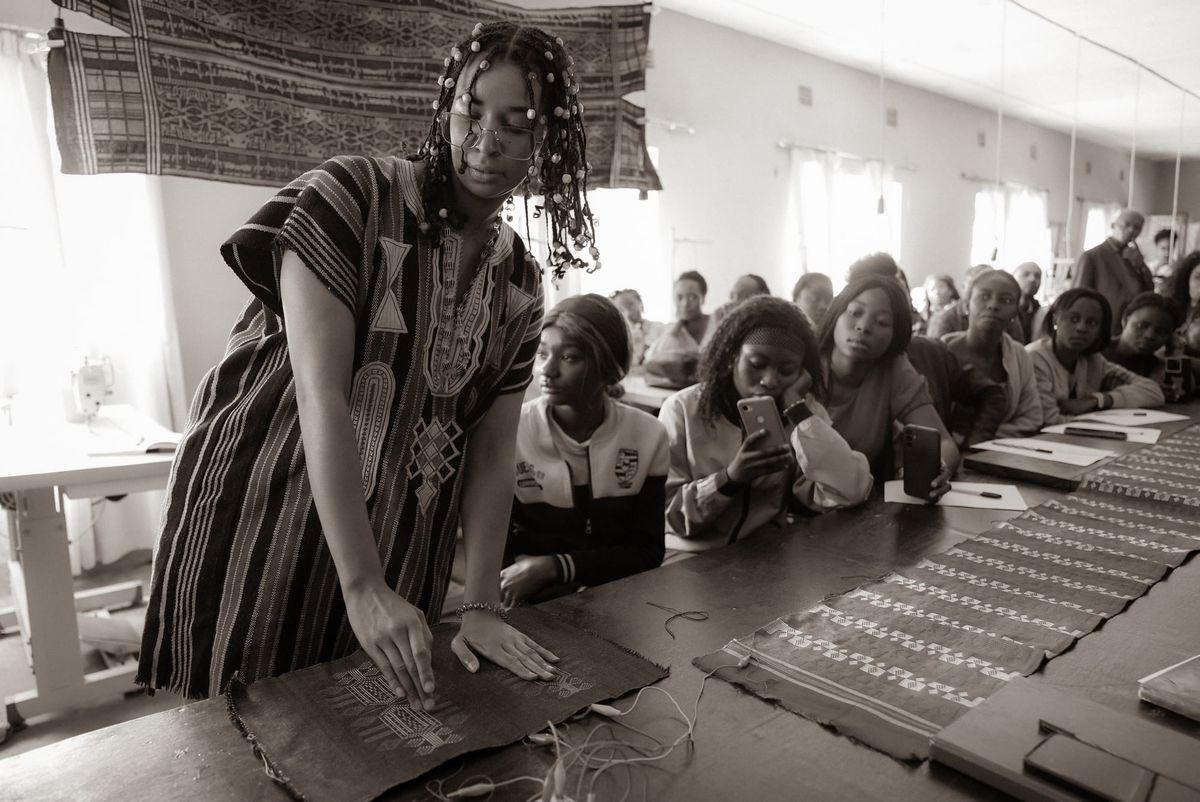
Cover: Diane Cescutti, on “fibril and vivid memory: From hard to soft connectivity” at ISAM Institut Supérieur des Arts et de Métiers; held in collaboration with the Waza Art Centre (Lubumbashi) and the Humboldt Forum (Berlin); photo: Nathan Bushiru © South-to-South.
Fig1. Diane Cescutti, on “fibril and vivid memory: From hard to soft connectivity at ISAM Institut Supérieur des Arts et de Métiers,” held in collaboration with the Waza Art Centre (Lubumbashi) and the Humboldt Forum (Berlin); photo: Nathan Bushiru © South-to-South.
Jean Kamba lives and works in Kinshasa. He is a poet, independent researcher, art critic, curator, and executive director of Krithika Artprojects, who has organized several exhibitions since 2013. He regularly publishes essays and reviews in national and international journals and catalogs. For several years, he has participated in several international art-related meetings and events.