
As vectors of contemporary urbanity, suburbs are environments marked by mobility and anormativity. They may be defined as informal ecosystems where pollution and self-construction overlap with the infrastructural landscape, housing scarcity, and remnants of pre-urban nature. einaidea's new intensive program, PERI\FERAL, focuses on such post-urban scenarios to explore the artistic and conceptual potential of liminal zones. In the periphery, the abandonment and precariousness of some enclaves confront the aspirational redesign of nearby habitats. Here, we become aware of the city and its tentacular, i.e., non-linear growth, but also reckon with the city as an organism without membranes, a nervous system whose faultlines become manifest on its edges. With the center at an ever greater distance, the suburban signifies less a boundary than a subconscious dimension of the city. Vacant lots, warehouses, storage facilities, small patches of protected nature, residential developments, obscure monuments, ring roads, reclaimed landfills, resource centers, shantytowns… Invariant elements of an accidental, fragmentary urbanism that urban planning has always treated as residual.
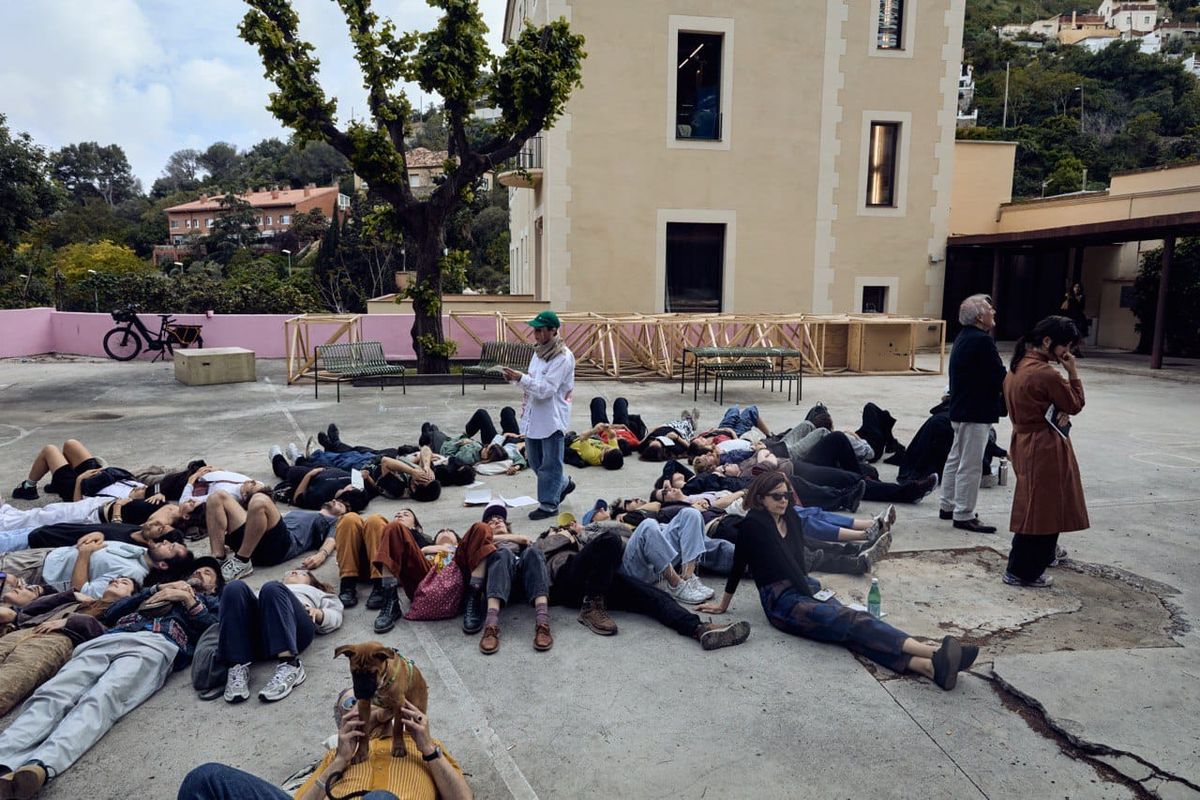
PERI\FERAL focuses on the experimental observation of the city through its rearguards, using the outskirts of Barcelona as a testing ground. In a cross-disciplinary manner, bringing together practices in art, architecture, and ecology, PERI\FERAL explores unregulated or vacant, heterogeneous, mutating, wild, or rewilded (in that sense, “feral”) areas offering key insights to understand current transformations of contemporary life. The program will offer intensive workshops, lectures, and field explorations, taking the multifarious outskirts of Barcelona as a case study. It will also support each student’s individual research, providing new perspectives and methodologies for the development of both theoretical and practical projects. Between April and June 2026, PERI\FERAL will alternate between in-person activities and online presentations, culminating in a symposium and a public exhibition of participants’ final projects.
The diversity and ambiguity of peripheral spaces make them peri-feral, thus conferring a wild or untamed dimension to such poorly monitored enclaves. Their ambiguity, between the unbuilt and the abandoned, fosters a series of study exercises that will traverse disciplines such as architecture and speculative urbanism, collective and site-specific artistic practices, ecology, and sound experimentation. Through practical workshops, masterclasses, sound walkthroughs, and observational outings, PERI\FERAL will foster new dynamics of research and interaction with the city’s borderscapes and their unknown strata, seeking to open unusual avenues for each participant’s practice. In this way, the program places a clear emphasis on experimentation and practice, punctuated by moments of theoretical synthesis. During the training period, individual and supervised research will alternate with knowledge sharing by referential creative agents and researchers. They will guide collective exploration processes in the territories surrounding us.
With each invited practice, PERI\FERAL will explore multiple formats that assemble, overlap, and challenge one another, over three and a half months. The program will feature the collaborations of artist, curator, and writer David Bestué; Jordi Colomer, artist and co-founder of La Infinita, L’Hospitalet de Llobregat; Patricia Dauder, artist; forty five degrees, architecture and research studio, Berlin; Lara García Díaz, sociologist and researcher; María García Ruiz, artist and researcher; Sunny Graves, sound artist and music producer; Mathias Klenner, artist and architect; Caterina Miralles, artist and architect; Mireia Molina Costa, artist and writer; Joan Rieradevall, ecologist; José Luis Uribe, architect and filmmaker; and Manuel Cirauqui, curator and director of einaidea.
For more info, visit: www.eina.cat/en/periferal
//
Image:
Copyright and courtesy of EINA.