
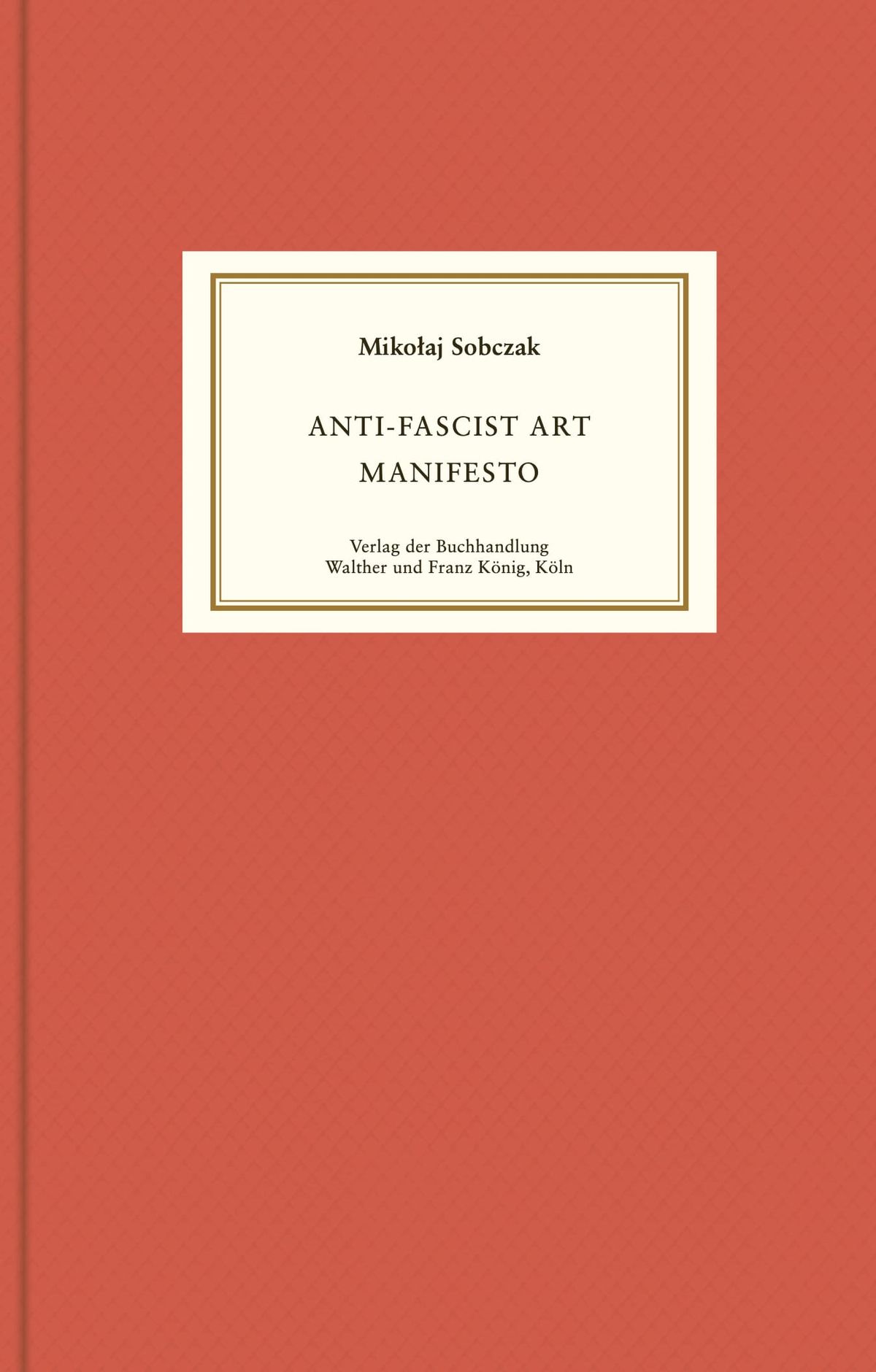
Anti-Fascist Art Manifesto by Polish artist Mikołaj Sobczak came about after the author and a friend suffered a hate crime in Poland in 2021. One night, when they were coming back from a concert, teenagers clocked them as gay, called them slurs, chased them down, and beat them in the street. Sobczak’s nose was broken. He found refuge in a nearby gas station. The attendant let the “night birds” inside and locked the door, which the bloodthirsty gaggle tried to break down, Sobczak writes.
Sobczak’s friend was both queer and not European, amplifying the fury of the aggressors. The episode changed Sobczak’s life, the way he thinks about art, and what artists can and should do when fascists are doling out vitriolic hate to impressionable adolescents. “I want my art to counter right-wing and fascist narratives. So hunts for night birds happen less often,” he says. Sobczak stresses that “anti-fascist art must stop just mirroring the world. It must go deep and get ahead of it. Art must not wait for victims to die before documenting their struggles.” The publication, released by Walther König this summer, does so by speaking directly to artists and offering critical analysis paired with first-person accounts of surviving fascism as a queer minority
As a point of departure, the book asks, “Does art have any real power?” Sobczak’s answer is yes, but it’s rightfully complex. “Art can reframe the narratives that underpin fascism. They affect the unconscious, which influences most of our daily decisions,” he writes. “By boldly transforming our experiences into creative products, such as personifications, symbols, and stories, we channel this potential. We pave the way for imagination and the cultural economy to drive anti-fascist change. This redirects our frustration toward the true source of the problem: the ruling class.”
For Sobczak, the question at hand isn’t how to destroy fascism, or “how to replace it, but rather how to use the cycle of reborn fascism against itself. Leaning on Greek mythology, Jungian psychology, and philosophers such as Theodor Adorno, Hannah Arendt, Jean Baudrillard, Joanna Ostrowska, Michał Heree ( author of Where Does This Fascism Come From?), and Klaus Theweleit (author of Male Fantasies), Sobczak wants us to complicate categories and identities, and to avoid creating false illusions. In the same vein as Herbert Marcuse, Sobczak argues anti-fascist art disarms fascism by foregrounding our own latent, repressed imaginaries—the sexual encounters and societies we dream of that fascists demand we bury in our subconsciences.
The manifesto is coupled with Sobczak’s own beautiful drawings from a residency in 2023 at Mataré-Haus in Düsseldorf, which he describes as attempts at “trying to update the nineteenth-century genre of academic historical painting.” Drawing and collaging preceded the writing, which happened later during another residency Sobczak had in Florence at Villa Romana. If historically, academic painting was meant to reinforce binaries between the powerful and the oppressed, can the same aesthetic be appropriated to smash this division and uplift the latter? Sobczak offers elucidating attempts at an answer.
Sobczak deploys thin, expressive strokes that swirl in tenebrist, abstract realist compositions. We see an overlay of the ancient Greek lyric poet Sappho, from the island of Lesbos, over a portrait of Eva Kotchever, the author of Lesbian Love (1925). Another rendition shows Hermes on the cusp of fellatio with the Demiurge. In Destroying a Monument, figures use axes to tear down a statue of a dictator; to the side someone is reading a book—is this a prophet leading us into the future or just a revolutionary taking a coffee break? We can be both. Mladen Stilinović in his manifesto, In Praise of Laziness (2011), reminded us of how important it is to be lazy! The ambiguity is joyous, playful, and intentional.
Overall Sobczak’s locution is punchy, economical, and concise. He writes with purpose, lucidity, and courage. Sobczak’s gestalt meditations remind me of Paul Klee’s drawings he made after fleeing Germany in 1933, the subject of “Other Possible Worlds”, an exhibition at the Jewish Museum in New York City curated by Mason Klein. There are also traces of Hannah Höch, the queer German DaDa artist known for combining collage and figurative painting to create allegorical ensembles about desire and gender-politics in the Weimar Republic.
Sobczak lays out the principles of anti-fascist art in the Manifesto’s conclusion. For Sobczak anti-fascist art is an apophatic, negativist category. That is to say, we can understand anti-fascist art by identifying what it is not. “Anti-fascist art strongly opposes the ideas and attitudes promoted by fascism,” Sobczak said. “It challenges how schools, factories, hospitals, and prisons discipline us. It uses creativity to question and disrupt established hierarchies.”
Anti-fascist art is “often messy, unfinished, or even purposely falling apart,” and even “dirty”. Because, Sobczak affirms, “nothing is permanent,” and because we need to challenge fascism’s zest for uniformity, cleanliness, productivity, efficiency, order. Anti-fascist art “does not believe that reason or logic should control everything. Instead, it appreciates wildness and people’s collective imagination.”
Sobczak’s manifesto encourages readers to make connections between anti-fascist artists, living and dead. My co-authors, Andrew Santa Lucia, Lane Rick, and I attempted something similar in Antifascist Architecture. In our book, we posited a concept that we call the “antifascist avant-garde continuum”, a historical category that enables us to decouple architects from movements (e.g., futurism, surrealism, etc.) that can be home to both fascists and antifascists. We also try to dismantle the fascist business ontologies that choke our imaginations.
This operation is vital. Through books such as Anti-Fascist Art Manifesto, and others including Feminist Antifascism (2021) by Ewa Majewska, Anti-fascist Economics by Isabella Weber, and The Black Antifascist Tradition by Jeanelle K. Hope and Bill V. Mullen, a new generation of anti-fascist intellectuals is emerging—for obvious reasons. “Antifa”, a non-existent organization, was designated a domestic terrorist group in the country where I live by President Donald Trump in 2025. The Argentinian President Javier Milei calls Marxism “satanic theory”, parroting language common in Francoist Spain.
Beyond the immediate emergency, the grassroots surge in anti-fascist literature has more complex underpinnings. I think the operative lexicon we’ve inherited from the “New Left” for fighting fascism is inadequate. There’s a palpable need for reinvention. In Deleuze and Guattari’s Anti-Oedipus, anti-fascism was criticized as a political project by Michel Foucault, Deleuze, and Guattari as “anti-intellectual”, expressing instead their combined interest in “non-fascism” and “non-Nazism,” frameworks that challenged us to “kill the cops in our heads”.
Foucauldian “non-fascism” was meant to combat “post-fascism,” a form of fascism more dispersed across institutions and thereby less tangible and more de-centralized than historical fascism. Non-fascism is an interior pursuit where we, as individuals, reckon with our desire for power that supposedly makes us all capable of being fascists. By comparison, anti-fascism is an external, collectivist category more interested in survival than mental gymnastics for the managerial class. Today, the longstanding allergy to anti-fascism is waning, because non-fascism really doesn’t have anything to offer us at this terrible moment.
Many artists are anti-fascists, but Anti-Fascist Art Manifesto is the first attempt, at least to my knowledge, at providing a formula for what exactly constitutes anti-fascist art. This is productive and brave because it gives us something to debate, a foundation to grow from. Sobczak deserves credit for going out on a limb like this. Anti-Fascist Art Manifesto is essential reading for navigating our own time of monsters.
//
Cover Image
Mikołaj Sobczak, Anti-Fascist Art Manifesto, Walther König, 2026
Daniel Jonas Roche is a co-author of Antifascist Architecture (Park Books, 2026). He lives in New York City.